


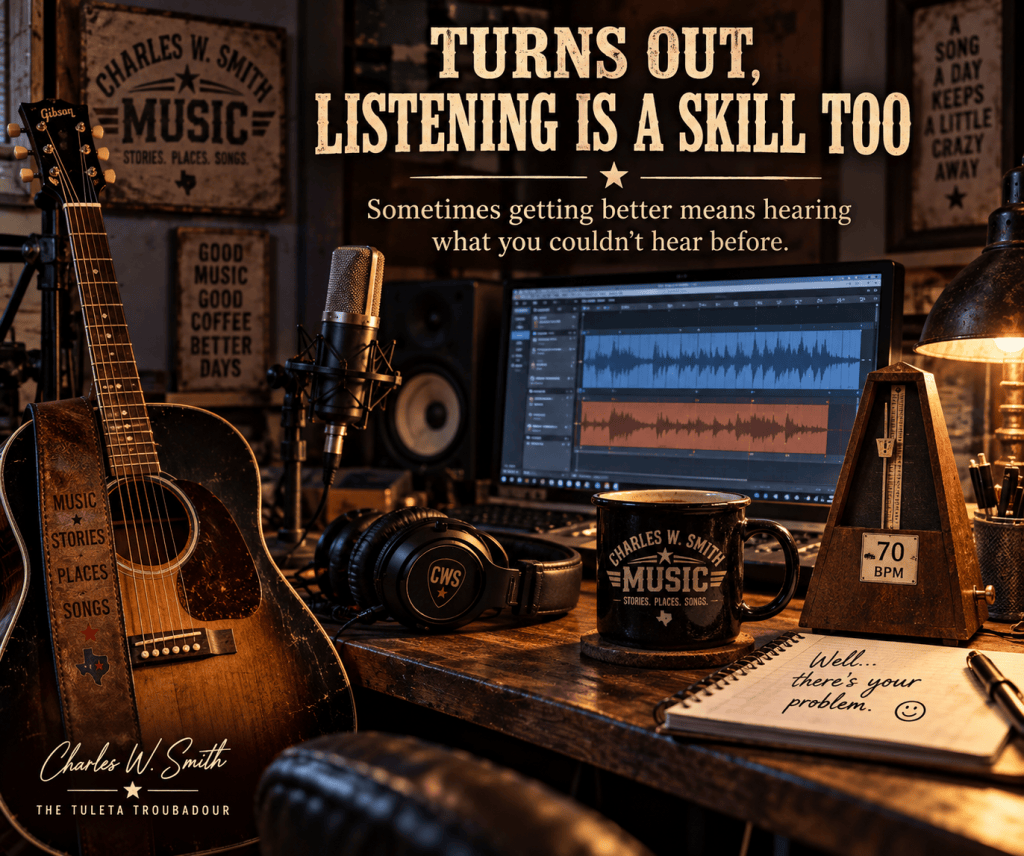
I recently made my first real studio recording of one of my original songs, “The Closed Door.”
I went into the whole thing figuring the hard part would be playing the guitar and singing the song without screwing something up.
That certainly turned out to be part of it.
What I didn’t expect was how much I was going to have to learn after I stopped playing.
Apparently recording music and listening to music are two entirely different hobbies.
Who knew?
Four Takes and a Whole Lot of Learning
I recorded four complete takes of “The Closed Door.”
Just me, my Gibson J-45 and a microphone.
Well, technically a couple of microphones, a mixer, a computer, recording software, headphones, cables running everywhere and enough buttons and knobs to make the space shuttle look reasonably straightforward.
But the music itself was simple.
A guy and a guitar.
That’s the way I wanted it.
I wasn’t trying to make some giant Nashville production out of it. I wanted it to sound natural. Pretty much the same thing you’d hear if I sat down a few feet away and played the song for you.
Just hopefully without the dog barking or somebody’s phone going off.
I recorded the guitar and vocal separately so I could work with each one afterward, then picked the best of the four takes.
Take four won.
Mostly because I managed to get all the way through the song, liked the performance, and even played the intro and ending the way I intended.
Sometimes success is about setting realistic expectations.
Then Came All the Knobs
Once I had the recording, I started learning how to mix it.
This opened an entirely new can of worms.
EQ.
Compression.
Reverb.
Limiters.
Levels.
Loudness.
Peaks.
High-pass filters.
Words I’d heard before but had never particularly needed to care about.
For most of my life, I’ve listened to music the way normal people listen to music.
I like that.
Or…
I don’t like that.
Pretty efficient system, really.
Now I’m sitting there wondering whether my guitar has too much low-mid frequency buildup.
I’ve become the kind of person I used to avoid at parties.
Apparently becoming a recording engineer involves spending twenty minutes moving a knob approximately the width of a gnat’s rear end, then switching it back and forth six times trying to decide whether anything actually happened.
Sometimes I could hear the difference.
Sometimes I couldn’t.
Sometimes I was pretty sure I could.
Then I’d switch it back and decide maybe I couldn’t.
After awhile, I wasn’t entirely sure I could hear anything anymore.
My Ears Are Beginners Too
That’s when I realized something.
I’ve spent a lot of time thinking about learning to play guitar.
My fingers had to learn where to go.
They had to learn chord changes.
Rhythm.
Timing.
How hard to hit the strings.
How to keep playing while I’m singing something completely different from what my right hand is doing.
My voice has gone through the same process.
I’ve learned more about breathing, pitch, microphone technique and how to use this deep voice God gave me instead of wishing it sounded like somebody else’s.
But I never thought much about training my ears.
I’ve listened to music my entire life.
That doesn’t necessarily mean I’ve learned how to hear it.
There’s a difference.
Now I’m trying to notice little things I never paid attention to before.
How the vocal sits against the guitar.
How much space there is around the voice.
Whether the guitar sounds full or muddy.
Whether a little reverb adds depth or makes it sound like I’m singing from the bottom of a stock tank.
Whether something actually sounds better or it’s just louder.
Those are learned skills too.
And right now, my ears are probably about where my fingers were when I first learned G, C and D.
They know just enough to get themselves in trouble.
I Thought It Sounded Pretty Good
Eventually, I got the recording to a place where I was pretty happy with it.
Not perfect.
I knew there were mistakes.
There was a guitar note I had to tame.
There was a vocal phrase I wasn’t completely happy with.
There were plenty of little things I knew I’d do differently next time.
But this wasn’t supposed to be the final masterpiece.
The whole point was to learn how to record one of my songs from beginning to end.
And I did.
I mixed it.
Exported it.
Listened through headphones.
Listened on my phone.
Listened in the truck.
Made changes.
Exported it again.
At some point I probably knew that recording better than I knew the original song.
And underneath all of that fiddling around, something kept bothering me.
The dang thing was dragging.
Seventy Beats Per Minute Seemed Like a Good Idea
Before I started recording, I needed to choose a tempo.
I’d played “The Closed Door” a jillion times during my livestreams, but I’d never actually known what tempo I was playing it.
I like the song slow.
The words need some room.
It’s not a song I want to rush through like I’m trying to finish before the parking meter expires.
So I tapped out a beat that felt right.
70 BPM.
Sounded good to me.
We recorded it there.
But after living with the finished recording for a few days, I kept having the same thought.
It’s too slow.
Then I’d talk myself out of it.
No, that’s how the song is supposed to feel.
It’s supposed to breathe.
Don’t rush it.
Leave it alone.
So naturally I did what any reasonable person does when his ears are telling him something he doesn’t want to hear.
I ignored them.
Then Tammy Heard It
A few days later, Tammy and I were headed down to South Texas and listened to the recording in the truck.
That’s become one of my favorite places to check a mix anyway.
I know what music sounds like in there.
We listened for a while.
Then Tammy mentioned that the song seemed just a little too slow.
Well, hell.
There it was.
The exact thing I’d been thinking and trying to dismiss.
I didn’t need another compressor.
I didn’t need another EQ adjustment.
I didn’t need three more hours of moving knobs around the width of a gnat’s rear end.
I needed to play the dang song a little faster.
😂
Live and Recorded Aren’t Quite the Same
That taught me something else.
The way a song feels when I’m performing it live isn’t necessarily the way it feels on a recording.
During a livestream, I’m singing it in the moment.
I’m feeling the words.
I’m controlling the phrasing.
There are people commenting and listening.
I’m watching the screen, playing the guitar and interacting with everybody.
There’s energy around the song.
On a recording, none of that exists.
The song has to stand there all by itself.
And when I listened to “The Closed Door” that way, those extra spaces that felt good while I was performing started feeling a little too long.
Not terribly.
Just enough.
But once I heard it, I couldn’t unhear it.
That’s probably a good thing.
The First Recording Did Its Job
So I’m going to record it again.
A little faster this time.
And strangely enough, I don’t consider that first recording a failure at all.
Quite the opposite.
That recording taught me more than I expected.
I learned how to capture my vocal and guitar separately.
I learned how to edit them.
I learned what compression does.
I learned what too much processing does.
I learned that I prefer my voice sounding natural with a little space around it.
I learned how my J-45 sits underneath my voice.
I learned that louder doesn’t necessarily mean better.
I learned that you can listen to the same ten seconds of a song so many times that you begin questioning every decision you’ve made since junior high.
And I learned that 70 BPM is too dang slow.
That’s a pretty good return on four takes.
Sometimes Progress Sounds Like a Mistake
I’m beginning to think this is how learning anything works.
You do the best you know how to do.
Then you learn a little more.
And suddenly you notice something you couldn’t notice before.
When I first picked the guitar back up, I couldn’t hear half the mistakes I can hear now.
That’s not because I’m getting worse.
It’s because I’m getting better at hearing them.
There’s an odd little cruelty in that.
The better you get at something, the more clearly you can see how far you still have to go.
But I suppose that’s progress.
Maybe the goal isn’t getting to the point where you stop making mistakes.
Maybe it’s getting to the point where you can finally hear them, understand them and know what to do differently next time.
My Ears Are Catching Up
I’ve spent the last few years teaching my fingers to play again.
I’ve been teaching my voice what it can do.
Now, apparently, it’s my ears’ turn.
They’re a little stubborn.
They’ve also got a few miles on them.
But they’re learning.
And that first recording of “The Closed Door” will always mean something to me, even if nobody else ever hears that particular version.
It was the first time I took one of my songs from sitting alone with a guitar all the way through recording, mixing and mastering something I could play back in the truck.
That’s a pretty big step for a guy who started all this because somebody handed him a guitar again and scared the hell out of him by saying, “Play something.”
The next recording will be better.
The one after that probably will be too.
And somewhere down the road, I’ll probably listen back to those and hear things I don’t know how to hear yet.
That’s okay.
Sometimes learning doesn’t mean you finally have all the answers.
Sometimes it just means you can hear the next question.
Now I just have to record the whole damn song again.
😂🎸🎙️

